
PollyKit Instructions
How to Use Your PollyKit
Follow these simple steps to collect your air sample and send it back for analysis.
The whole process only takes a few minutes to set up. Let the PollyKit hang for 24–48 hours, then mail it back in the prepaid envelope.
Watch the PollyKit Setup Video
A short walkthrough of setup, collection, and return mailing.
The PollyKit Instruction Card
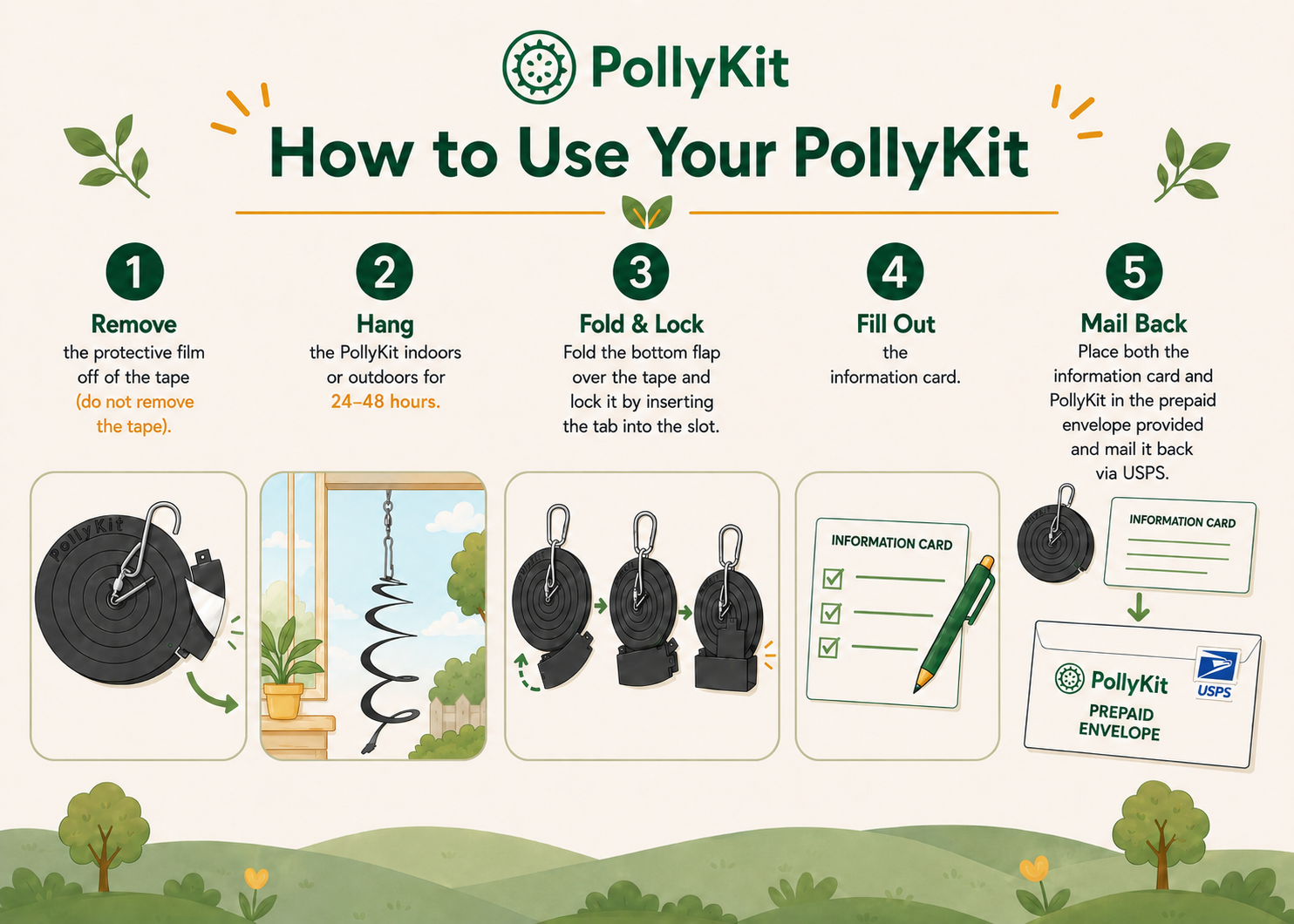
This is the same card that came in your kit — all five steps at a glance.
Step-by-step instructions
Step 1: Remove the protective film
Remove the protective film from the tape.
Important: Do not remove the tape itself.
Step 2: Hang your PollyKit
Hang the PollyKit indoors or outdoors for 24–48 hours.
Choose a location where air can move around the sampler. Avoid placing it somewhere it will be touched, covered, or directly exposed to water.
Step 3: Fold and lock the flap
After 24–48 hours, fold the bottom flap over the tape to protect the sample.
Insert the tab into the slot to lock it closed.
Step 4: Fill out the information card
Complete the information card included with your PollyKit.
This step is very important because it tells us where and when the sample was collected.
Step 5: Mail it back
Place both the PollyKit and the completed information card into the prepaid envelope provided.
Mail it back via USPS.
Before mailing your PollyKit back, make sure:
- You removed only the protective film, not the tape.
- The PollyKit hung for 24–48 hours.
- The bottom flap is folded and locked.
- The information card is completed.
- Both the PollyKit and information card are inside the prepaid envelope.
Where can I hang the PollyKit?
You can use PollyKit to test air from:
- Inside your home
- Your yard
- Your patio
- Your office
- A classroom
- A neighborhood location
- Another area where you want to understand what is in the air
Need Help?
If you have questions about using your PollyKit, email us and we’ll be happy to help.
For the best results, please include your name and any PollyKit order or case information if available.